
Liposuction removes fat from selected areas to refine body shape, but the result depends less on how much fat is taken than on where and how. At JEUNEX Clinic in Seoul, liposuction is planned around overall proportion: fat distribution, skin elasticity, muscle and bone structure, and how each area connects to the next, so the outcome looks balanced rather than simply smaller.
In this article
- Why does proportion matter more than how much fat is removed?
- Which areas can liposuction address?
- What does the liposuction process involve?
- Which devices are used, and why does it vary?
- What is recovery from liposuction like?
- What are the risks of liposuction?
- When might liposuction not be the answer?
- Liposuction or a non-surgical option?
- How should you plan liposuction around a trip to Seoul?
- What should you look for in a liposuction clinic in Seoul?
- How is the right amount of fat to remove decided?
- How do the main liposuction devices compare?
- How do you prepare for liposuction?
Why does proportion matter more than how much fat is removed?
Reducing fat evenly does not automatically create the body shape people want. Fat layers vary in thickness from one area to another, and neighbouring areas meet along borders: the arm and shoulder, the abdomen and waist, the thigh and knee. If one area is treated in isolation, steps, dents or imbalance can appear where it meets the next.
That is why JEUNEX Clinic separates what should be reduced from what should be kept. Some volume is worth preserving because it contributes to a natural line. The clinic’s fat expertise is led by a doctor with more than 25 years of experience in fat-related medicine, spanning liposuction, fat grafting and fat-derived SVF.
Which areas can liposuction address?
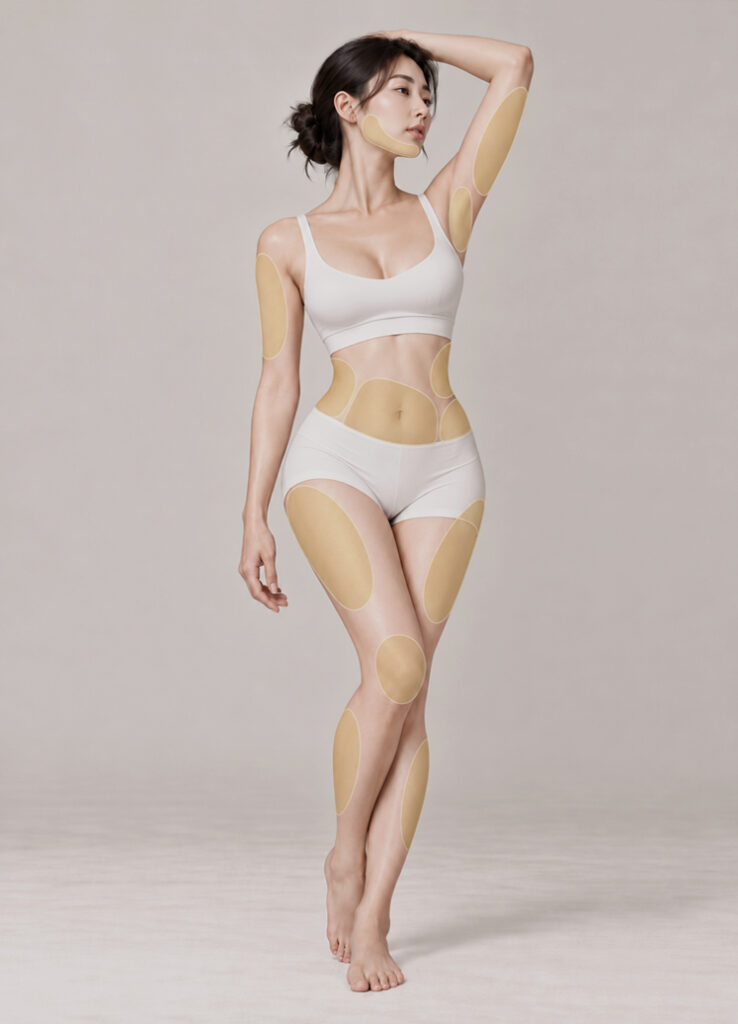
- Cheeks and jawline: fat distribution on the face and under the chin, together with skin elasticity
- Shoulders and arms: fat on the upper arm in proportion to the whole arm
- Back and bra line: fat around the back and flanks, including where skin folds
- Abdomen and waist: upper and lower abdomen, flanks and lower back planned together
- Thighs and knees: inner and outer thighs and around the knee, including left–right differences
- Calves and ankles: separating fat from muscle development to judge whether liposuction is suitable
- Male chest: treatment depends on whether fat or glandular tissue is the cause
- Revision: unevenness, asymmetry or remaining fat after previous liposuction, assessed for further removal or fat grafting
What does the liposuction process involve?
At JEUNEX Clinic, liposuction runs as one process from consultation to recovery:
- Consult: fat distribution, skin and tissue condition and the area to be improved are assessed.
- Design: the extent and approach are planned with the proportions of neighbouring areas in mind.
- Procedure: liposuction follows the plan, checking each area as it goes.
- Recovery: swelling and bruising are monitored, with aftercare guidance.
- Follow-up: changes are reviewed and further care is planned if needed.
Which devices are used, and why does it vary?
No single device suits every body or area. JEUNEX Clinic selects equipment after examination, according to fat distribution, tissue condition and the purpose of the procedure. Devices in its line-up include:
- VASER Lipo and LSSA, which use ultrasound energy to emulsify fat and assist its removal
- Renuvion, which uses helium plasma and radiofrequency energy to help contract the tissue beneath the skin, considered where skin laxity accompanies fat removal
- Apolex Tite, which delivers radiofrequency heat beneath the skin to support firmness and contour
- V-Olet, a deoxycholic acid injection used for fat under the chin, an option where surgery is not the right fit
What is recovery from liposuction like?
Swelling and bruising are normal after liposuction, and the treated area can feel firm or tender while it heals. A compression garment is commonly advised to support the area as swelling settles. Light walking is usually encouraged early on, while strenuous exercise is resumed only when the doctor advises.
Because swelling takes time to resolve, the final contour is judged gradually rather than straight after the procedure. JEUNEX Clinic monitors recovery and checks each area at follow-up, adjusting aftercare guidance as needed.
What are the risks of liposuction?
Liposuction is surgery, and understanding its risks is part of making an informed decision. Risks commonly discussed include:
- Unevenness, dents or asymmetry, particularly where neighbouring areas meet
- Temporary numbness or altered sensation in the treated area
- Fluid collection under the skin
- Infection and, rarely, more serious complications associated with any surgery
Careful planning reduces several of these risks. Assessing borders between areas, deciding what volume to keep, and choosing devices to suit the tissue are all aimed at a smooth, balanced result. Where a previous liposuction has left unevenness, JEUNEX Clinic also assesses revision, using further removal or fat grafting as appropriate.
When might liposuction not be the answer?
Liposuction removes fat. It does not address every reason an area looks fuller or looser. Where muscle development shapes the calves, or where loose skin rather than fat is the main concern, another approach may be more appropriate. Sometimes the better question is not what to remove but where volume is missing, which is where fat grafting comes in. A good consultation should tell you if liposuction is not the right fit.
Liposuction or a non-surgical option?
Not every concern needs surgery. For a small amount of fat under the chin, an injectable such as V-Olet may be considered. Where skin laxity is the main issue rather than fat, a tightening treatment may be more appropriate than removal. Liposuction tends to be the relevant option where there is a defined area of fat that does not change with diet and exercise, and where reshaping, not weight loss, is the goal.
A consultation that weighs these options honestly is more useful than one that starts from a single procedure. See also how non-surgical lifting treatments differ.
How should you plan liposuction around a trip to Seoul?
If you are travelling for liposuction, build your plan around recovery rather than around flight dates. Ask the clinic how long to stay after the procedure, when follow-up checks are scheduled, and how compression garments should be worn during travel. Allow time for the swelling of the first days to settle before flying, and keep the clinic’s messaging contact so you can send questions once you are home.
What should you look for in a liposuction clinic in Seoul?
- Does the clinic assess proportion and neighbouring areas, or only the area you point to?
- Will the doctor explain what can and cannot change, and the recovery involved?
- Is device choice explained for your case rather than presented as one technique for everyone?
- Is there a clear follow-up plan after the procedure?
- Can the clinic discuss revision if you have had liposuction before?
How is the right amount of fat to remove decided?
Removing as much fat as possible is not the goal. The right amount depends on the thickness of the fat layer, how elastic the skin is, how the area relates to its neighbours and what is safe for your body. Skin needs to be able to contract smoothly over the new contour, so taking too much from an area with less elastic skin can leave it looking loose or uneven.
At JEUNEX Clinic, the plan sets both what to reduce and what to keep. Leaving a measured amount of fat in some areas preserves natural curves and avoids a hollow or over-treated look. Where skin laxity is a concern, the doctor may discuss tightening devices alongside fat removal, or suggest a more conservative approach.
How do the main liposuction devices compare?
Each device in JEUNEX Clinic’s line-up has a different role, and the doctor chooses after examining the area.
| Device | How it works | Commonly considered for |
|---|---|---|
| VASER Lipo | Ultrasound energy emulsifies fat before removal | Contouring areas with denser or fibrous fat |
| LSSA | Ultrasound energy assists fat removal | Areas where fat thickness and tissue vary |
| Renuvion | Helium plasma and radiofrequency help contract tissue beneath the skin | Fat removal where skin laxity is also a concern |
| Apolex Tite | Radiofrequency heat beneath the skin | Supporting firmness and contour |
| V-Olet | Deoxycholic acid injection | Small amounts of fat under the chin, without surgery |
Device choice affects how the procedure is carried out, but planning and technique matter as much as the equipment itself.
How do you prepare for liposuction?
Share your full medical history, medications and supplements, and any previous procedures in the area. Follow the clinic’s instructions on anything to pause beforehand, and on eating and drinking before the procedure. Arrange loose clothing that is easy to put on over a compression garment, and plan for rest in the first days. If you are travelling, allow time in Seoul for the follow-up checks the clinic recommends before you fly home.
Key takeaways
- Liposuction results depend on where and how fat is removed, not just how much.
- JEUNEX Clinic plans liposuction around proportion and the borders between neighbouring areas.
- Device choice, such as VASER, LSSA or Renuvion, depends on the area and tissue.
- A consultation should also tell you when liposuction is not the answer.
Frequently asked questions
Is liposuction a weight-loss treatment?
No. Liposuction refines shape by removing fat from selected areas. It is not a substitute for weight management, and planning focuses on proportion rather than numbers on a scale.
What is VASER liposuction?
VASER uses ultrasound energy to emulsify fat before it is removed. At JEUNEX Clinic it is one of several devices, chosen according to the area and tissue being treated.
Can liposuction be combined with skin tightening?
Where skin laxity is a concern, devices such as Renuvion or Apolex Tite may be considered alongside fat removal. Whether this suits you is decided after examination.
Can fat removed by liposuction be reused?
Harvested fat can, depending on the goal and suitability, be considered for fat grafting or an SVF programme. JEUNEX Clinic treats harvesting and use as one continuous process.
Will fat come back after liposuction?
Fat cells removed from an area do not grow back there, but the remaining fat cells can still enlarge if weight increases. Maintaining a stable weight helps keep the shape achieved.
Can men have liposuction?
Yes. Men commonly consider areas such as the flanks, abdomen and chest. For the chest, JEUNEX Clinic first assesses whether fat or glandular tissue is the cause, since that determines the right treatment.
Talking to JEUNEX Clinic
JEUNEX Clinic is in Cheongdam-dong, Gangnam, Seoul. International patients can reach the clinic through WhatsApp, LINE, WeChat or KakaoTalk; the messenger links are on the clinic contact page. It helps to share what you would like to change and any previous treatments before your visit.
This article is general information about treatment options and is not medical advice. Whether any procedure is suitable, and what it involves for you, can only be decided after a consultation and examination with a doctor.